

Why Do Corporate Decarbonization Plans Keep Stalling? 4 Common Execution Bottlenecks How to Integrate Consulting, Digital Platforms, and Decarbonization Solutions Across Project Stages

Why Do Corporate Decarbonization Plans Keep Stalling? 4 Common Execution Bottlenecks How to Integrate Consulting, Digital Platforms, and Decarbonization Solutions Across Project Stages
Energy assessments have long been common practice across industry. In pursuing energy efficiency and decarbonization, many companies engage multiple service providers simultaneously, assigning responsibility for advisory assessments, system implementation, and equipment upgrades to different parties. The real implementation challenge is often not a lack of qualified providers, but whether successive stages can be effectively connected and aligned around consistent improvement objectives so that energy-saving measures deliver their intended results.
Evidence of this implementation gap can be found in the data. Since 1981, the U.S. Department of Energy's Industrial Assessment Centers (IAC) program has provided free energy assessments to small and medium-sized manufacturers, generating a substantial body of publicly available longitudinal data. A study examining more than 20,000 assessments and over 150,000 recommendations made between 1981 and 2022 found that only 47% of the recommendations were implemented. In other words, more than half remained unimplemented despite having undergone professional assessment and quantification of their expected benefits.
Insufficient funding is not the only reason improvement recommendations fail to materialize. Within a company's implementation process, energy assessments, system development, and equipment upgrades may be commissioned from separate suppliers: consultants close out their engagement upon delivering the assessment report; platform providers then build systems based on that report; and engineering contractors subsequently carry out equipment improvements. Each handover can lead to a redefinition of assessment baselines and disrupt continuity with the preceding stage. Accordingly, when evaluating an "end-to-end service," companies should look beyond the number of services a provider offers and ask whether those services are genuinely integrated, whether different teams can build effectively on earlier work, and whether proposed improvements can actually be implemented.
Common "End-to-End Service" Models in the Market
Energy management and the implementation of energy-saving solutions generally involve 3 stages. Consultants first conduct assessments to establish the current situation and identify opportunities for improvement. Digital platforms then enable monitoring and tracking. Finally, engineering works translate the proposed measures into equipment upgrades.
These stages require different areas of expertise and are often procured separately: consulting firms conduct assessments, software vendors implement systems, and equipment suppliers or engineering contractors execute the physical works.
In practice, integration models vary. Some providers begin with advisory services and extend their offering to systems implementation and engineering works. Others build around a software platform, integrating assessment services upstream and engineering execution downstream. Still others start with equipment or engineering services and add preliminary assessments and subsequent monitoring. Although their entry points and areas of expertise differ, they share a common proposition: a single point of contact coordinates the entire process, reducing the time and resources companies must devote to managing multiple parties.
From a procurement and external coordination perspective, a single point of contact can indeed reduce administrative burdens. However, receiving all services from one provider does not necessarily mean that assessments, digital platforms, and engineering teams apply consistent evaluation baselines.
In practice, gaps most frequently emerge in 3 areas:
-Energy savings and Return on Investment (ROI):
The energy baseline established during the assessment phase may need to be reconfigured during system implementation because the parties use different key variables or calculation periods. Following the completion of engineering works, measured data may also be incompatible with the original estimation methodology, leaving no mutually accepted basis for determining energy savings and investment returns.
-Execution and coordination:
If the measures listed in an assessment report have no clearly designated owners, deadlines, or central coordinating function, they may remain on paper after the report is delivered, with little prospect of implementation.
-Budget allocation:
Even when improvement measures have been prioritized, their ranking may have little practical value if funding sources have not been confirmed and the company discovers at the formal proposal stage that the necessary budget cannot be allocated.
Even when one provider contracts for the entire scope, its individual teams may not apply consistent methods. Put simply, consolidating the point of contact does not automatically eliminate gaps at handover. The focus of evaluation should therefore shift from "How many services can this provider offer?" to "How effectively can the stages be integrated, and can improvement initiatives continue to move forward?"
Coordinated Delivery Across Consulting, Digital Platforms, and Decarbonization Solution
An alternative is to establish consistent foundations across all 3 functions from the outset: a shared energy baseline, common performance indicators, and a unified project record. Rather than completing their assignments separately and handing them off in sequence, the 3 functions work collaboratively throughout the same project. Their respective roles are as follows:
-Consulting services:
Energy specialists undertake on-site reviews, identify energy-saving opportunities, establish energy baselines and performance indicators, and prioritize improvement measures.
-Digital platforms:
Building on the indicators and energy baselines defined during the consulting phase, digital platforms continuously monitor energy consumption, track project progress, and verify improvement outcomes.
-Decarbonization solutions:
These provide energy-saving technologies and engineering implementation services for a range of applications, including factories, green buildings, and data centers.
These functions do not enter the project one after another; they collaborate continuously within a common operational framework. Team leaders participate from an early stage to understand the objectives of each improvement measure, its implementation requirements, and the subsequent verification process, minimizing information gaps during handover. The 4 stages of an energy workshop illustrate this approach:
Roles of the 3 Functions Across 4 Process Stages
Step 1 — Energy Review and Identification of Energy-Saving Opportunities:
The consulting team reviews the existing energy balance and energy-use distribution across facilities, validates the list of Energy-Saving Measures (ESMs), and evaluates the potential savings associated with major energy-consuming equipment and systems, including air conditioning, air compressors, and lighting. The digital platform helps identify potential opportunities through data analytics and questionnaires covering major energy-consuming equipment. The decarbonization solutions team assesses on-site implementation conditions, the feasibility of integrating existing equipment, and the need for additional devices, using the findings to prepare an initial implementation plan.
Step 2 — Prioritization of Improvement Measures and Implementation Roadmap:
The consulting team screens energy-saving measures based on factors such as technological maturity and investment returns. The digital platform applies the Marginal Abatement Cost Curve (MACC) to compare costs and carbon-reduction benefits across measures, providing an evidence-based basis for implementation priorities.
Step 3 — KPI and Energy Model Design:
The consulting team introduces an energy performance management framework, uses energy models to identify key variables influencing energy consumption, and establishes energy performance indicators aligned with "SMART Goals.[1]"」The digital platform configures monitoring indicators, alert thresholds, and notification mechanisms so that deviations from expected energy performance trigger timely alerts.
Step 4 — Target Setting and Performance Management:
All 3 teams jointly confirm the arrangements for implementation and verification. The consulting team defines reduction targets at the plant and system levels and establishes regular review procedures. The digital platform checks whether metering instruments are sufficient and data collection is complete. The decarbonization solutions team confirms how performance will be verified after engineering works are completed, ensuring continuity across all activities.
Under this division of responsibilities, the process no longer follows a model in which one stage ends before work is transferred to the next team. Instead, all 3 functions remain involved and work in parallel, reducing information gaps and execution discontinuities caused by handovers.
The consulting team helps companies define their decarbonization pathways and establish energy baselines and site-specific energy-saving indicators. The digital platform records the results of improvement measures and brings together energy-saving cases and actual investment-return data across sites in a shared case database. When planning new facilities, companies can draw on proven solutions instead of repeating assessments from scratch. A central team of energy specialists can also support assessments and reviews across locations, eliminating the need for every plant to maintain a complete in-house energy team.
Note:
[1] The SMART Goals is a goal-setting framework that helps teams achieve their objectives, improve work efficiency, and establish personal development goals. SMART is an acronym for 5 criteria that should guide effective goal setting: Specific, Measurable, Achievable, Relevant, and Time-bound.
Source: https://www.managertoday.com.tw/glossary/view/193?utm_source=copyshare
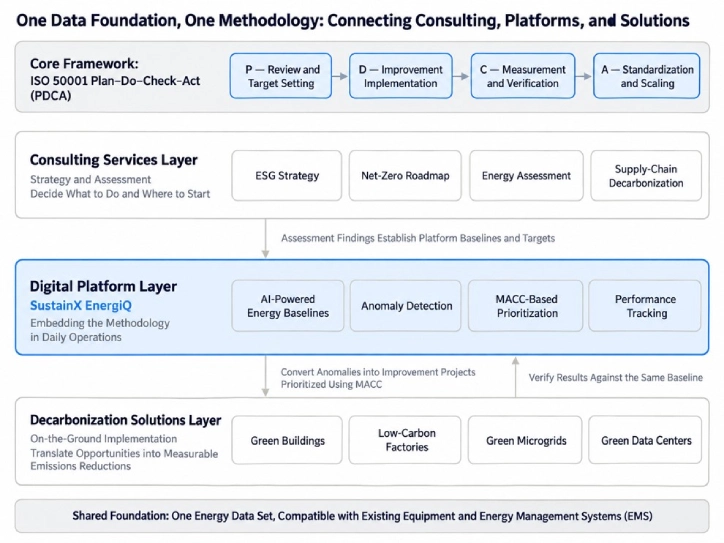
3Division of Responsibilities and Collaboration Among the 3 Functions Across 4 Process Stages
3 functions collaborate throughout one process, sharing energy baselines, performance indicators, and case data.
How Delta Developed This Operating Model in Its Own Facilities
This approach was not devised solely in response to market demand. Delta developed it progressively while pursuing energy efficiency within its own group operations.
In the early stages, Delta identified 4 principal challenges: a shortage of specialist personnel across regions, which hindered centralized management of energy-saving projects and the replication of successful practices; limited resources and funding within business units, making it difficult to deliver on headquarters' decarbonization targets; fragmented energy data, inconsistent standards, and heavy dependence on manual consolidation; and a lack of energy analytics tools, limiting the timely identification of energy-saving opportunities.
Resource and funding constraints, in particular, cannot be overcome through processes or tools alone; they also require supporting governance mechanisms. Delta therefore established an internal carbon pricing mechanism under which business units contribute internal carbon fees based on their emissions, creating a ring-fenced fund to support energy-saving projects at manufacturing facilities and R&D units. Budgets are formally allocated only after projects have been proposed, reviewed by specialists, and approved by management. This connects the improvement priorities established earlier with the budget approval process.
Scaling energy-efficiency practices across the group involves 4 steps.
First, headquarters establishes the direction, sets decarbonization targets, and progressively cascades them to global operations. Second, the company identifies energy-saving potential across facilities, assesses their maturity, and groups them accordingly. Third, on-site audits and support from a central team of energy specialists help develop commercially viable benchmark cases. Finally, successful approaches are replicated across other facilities. For many companies, the final step is the most difficult: achieving results at one plant does not necessarily mean that other plants can capitalize on that experience rather than starting again from scratch.
5 Questions Worth Asking When Evaluating End-to-End Services
The following 5 questions can be used to evaluate different suppliers; they are not intended to assess any particular product:
The following 5 questions can be used to evaluate different suppliers; they are not intended to assess any particular product:
How is the initial assessment conducted? Does the consultant simply deliver a report, or are the company's internal teams involved in jointly agreeing on the direction of improvements?
Can the energy baseline and performance indicators established during assessment be carried directly into subsequent system implementation, or must they be redefined?
When verifying improvement outcomes, are the actual data and original benefit-estimation methodology consistent? Who is responsible for validating the results?
Are the responsible units and completion deadlines for each improvement measure assigned during the assessment phase? Are funding sources also confirmed when priorities are determined?
When the approach is deployed at other plants, how much of the existing consulting workflow and platform configuration can be reused without modification?
Where Is Your Company Encountering Its Greatest Bottleneck?
For most companies, the challenge is not necessarily a weakness in all 3 functions. One function may be less developed, or coordination between stages may be ineffective. We welcome your comments below; you can also respond simply by selecting an option number:
① The assessment is complete, but improvement recommendations have not been implemented.
②A platform is in place, but the analytical and decision-making foundations are insufficient.
③The improvement strategy is clear, but funding is unavailable.
④ One plant has delivered results, but replication across other facilities remains difficult.
The next article will examine energy management systems in greater depth: how digital platforms can embed ISO 50001 requirements into day-to-day operations, rather than treating them as documents to be assembled ahead of an annual audit.
【Delta's ESG Integrated Planning Office- Department Introduction】
Delta's ESG Integrated Planning Office was established to transform decades of practical experience into professional services spanning ESG and net-zero strategy, carbon management, energy management and energy-efficiency improvement, and supply-chain decarbonization.
This depth of practical experience is what differentiates us. Before advising customers, Delta first applied sustainability principles to its own operations. The company has earned a CDP Double A rating for five consecutive years, achieved the highest ESG score in the global electronic equipment industry in the Dow Jones Sustainability World Index for seven consecutive years, and became one of the first industrial companies to have an SBTi 1.5°C target validated. What Delta provide to customers is not theory, but experience that has been implemented in practice, continuously refined, and validated across different operating environments.
Delta's services cover three core areas: ESG strategy, net-zero and energy transition, and supply-chain engagement. These capabilities are integrated with digital platforms, energy management, and end-to-end decarbonization solutions. Delta help companies move from target-setting to concrete execution, identify energy-saving opportunities, improve energy performance, and accelerate sustainability transformation through clearer pathways, stronger governance, and measurable outcomes.
For more information, please visit Delta's website: Delta ESG Consulting Services Website
More related articles
