

2026 BSI Standards Conference & AGM Focuses on AI Governance and Sustainable Value Chains, Leveraging International Standards to Build Business Confidence Amid Global Uncertainty
2026 BSI Standards Conference & AGM Focuses on AI Governance and Sustainable Value Chains, Leveraging International Standards to Build Business Confidence Amid Global Uncertainty
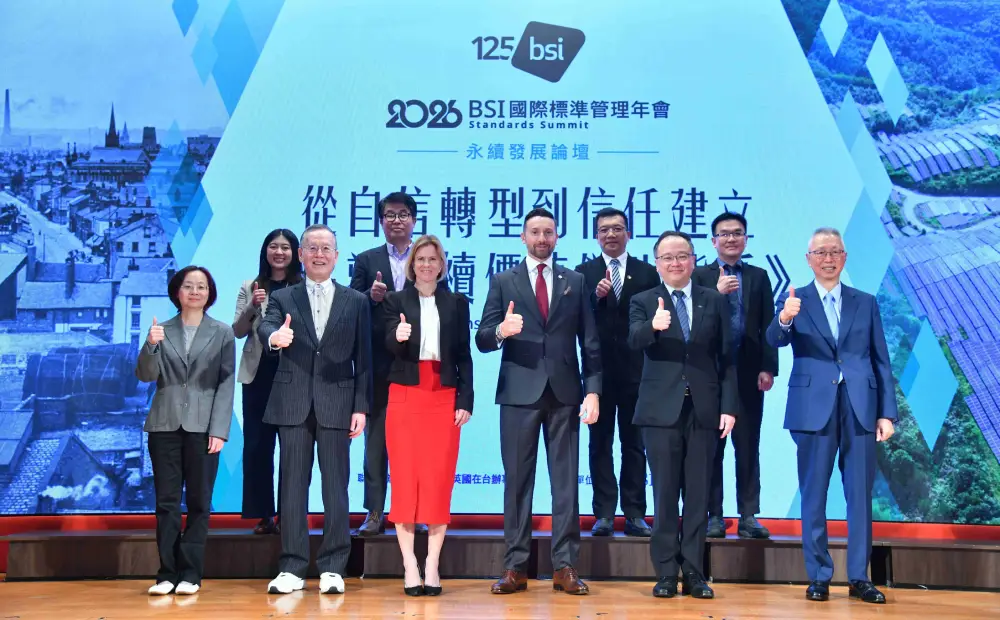
Facing challenges such as the rapid development of AI, growing global cybersecurity threats, the net-zero transition, and supply chain restructuring, strengthening governance resilience and building market trust have become critical business priorities. The "BSI Standards Conference & AGM 2026" held on 24th as part of the Global Corporate Sustainability Forum (GCSF) under the theme "Confidence in a Changing World," attracted nearly 800 experts and industry representatives from government, academia, and business. The conference focused on AI governance, digital trust, and sustainable development, exploring how international standards and cross-sector collaboration can help businesses navigate transformation challenges and enhance their global competitiveness.
At the conference, the British Standards Institution (BSI) and the Taiwan Institute of Economic Research (TIER) also signed a MOU. Building on their previous collaboration in developing PAS 247, a standard for monitoring and accounting for decarbonized electricity, the two organizations formally launched a joint initiative to develop PAS 248, a third-party verification specification. The initiative aims to enhance the credibility of emissions reductions achieved through decarbonized electricity, supporting Taiwan's industrial net-zero transition and alignment with international standards.
Confidence in a Changing World: From Governance Capabilities to Market Trust
Marking the 125th anniversary of BSI's global establishment and its 30th anniversary in Taiwan, Harold Pradal, President of Global Assurance at BSI, said: "AI is reshaping industries worldwide. Rapid technological advances are creating tremendous opportunities for innovation, but innovation alone is not enough. More importantly, we must build trust, ensure technology is secure, promote responsible AI applications, and equip organizations with the resilience to navigate change. Through international standards, independent third-party assurance, and cross-industry collaboration, BSI helps businesses transform rapid innovation into responsible and trustworthy progress."
He further noted that Taiwan plays an important role in global technology supply chains, leveraging its strong capabilities in semiconductors, advanced manufacturing, and information and communications technology (ICT). Taiwan is also a key force in shaping the future of technology.
This year's conference emphasized that as digital innovation and sustainability transformation increasingly intersect, businesses must do more than simply respond to change. They need robust governance capabilities to support long-term decision-making, risk management, and continuous improvement. International standards provide a common framework for managing business risks, while independent third-party assurance helps translate confidence in internal governance into trust among customers, supply chain partners, and the broader market.
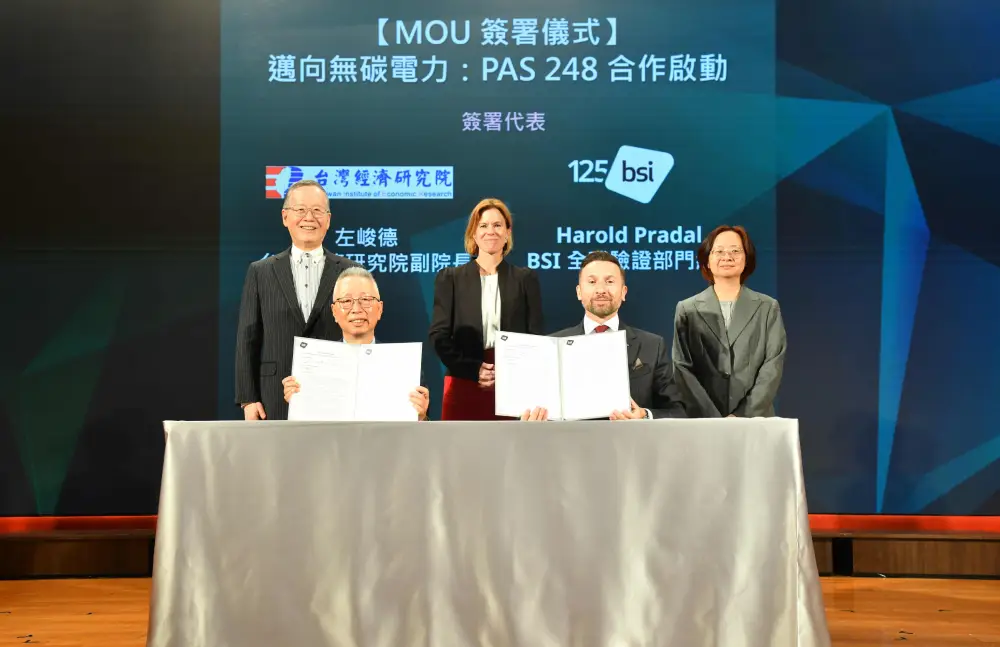
British Standards Institution (BSI) and the Taiwan Institute of Economic Research (TIER) signed an MOU, formally launched a joint initiative to develop PAS 248
Digital Trust: Moving Beyond Cybersecurity Defenses to Trust Operations, Strengthening AI Governance and Digital Resilience
This year's Digital Trust Forum, themed "Governing the New AI Landscape and Navigating a Trusted Future," focused on cybersecurity risks, governance challenges, and digital trust amid the rapid development of Agentic AI (代理式人工智慧).
Chun-Hao (Joe) Hsieh (謝君豪), Managing Director of BSI Northeast Asia, said: "AI technologies are transforming business operating models while introducing new cybersecurity and supply chain risks. As digital services and supply chains become increasingly interconnected, businesses must not only strengthen their own cybersecurity defenses but also incorporate AI governance, third-party risk management, and supply chain security into their overall management frameworks. This will enable them to drive innovation while ensuring operational security and continuity."
The forum also explored the application of ISO/IEC 27090:2026, which provides cybersecurity guidance for AI systems, and the ISO/IEC 42119 series of AI testing standards to strengthen AI risk management. Through transparency, robustness, and accountability, businesses can establish sustainable "Trust Operations" mechanisms (信任營運機制).
BSI also introduced its AI Foundation Framework (AIFF) and AI Mark of Trust (AI MoT) to help businesses enhance AI governance maturity and strengthen confidence in their management outcomes. Industry representatives from Hua Nan Financial Holdings (華南金控), TSMC (台積電), Hon Hai Research Institute (鴻海研究院), and DEVCORE were also invited to share practical experiences in AI governance and cybersecurity resilience from the perspectives of financial services, semiconductors, technology research and development, and cybersecurity offense and defense.
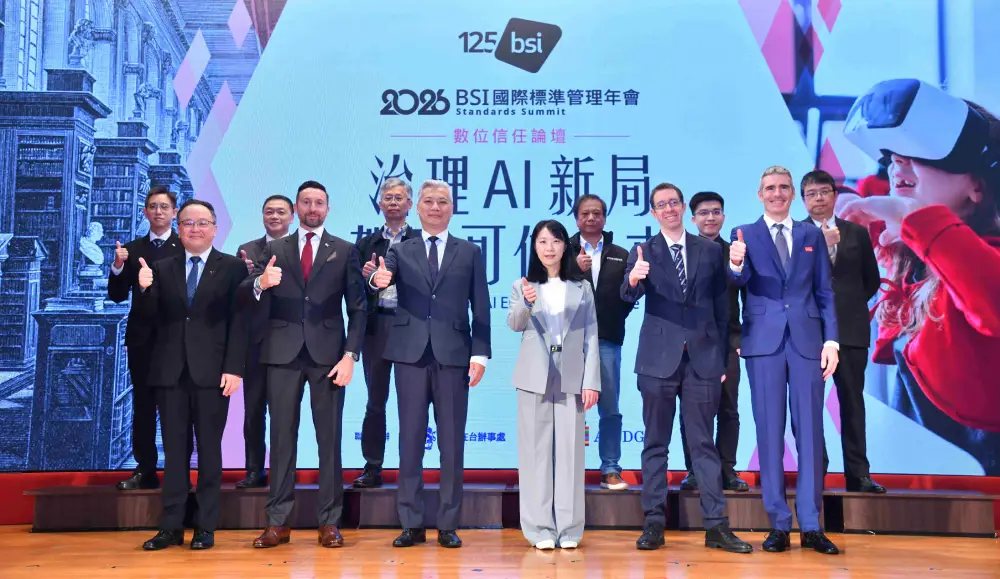
Sustainable Value Chains: From Confidence in Transformation to Building Trust, Turning Sustainability Commitments into Verifiable Competitive Advantages
This year's Sustainability Forum, themed "From Confidence in Transformation to Building Trust: Shaping a Sustainable Value Chain Ecosystem," examined how businesses can move beyond regulatory compliance toward proactive sustainability governance, extending decarbonization efforts from individual companies to collaborative action across entire value chains.
Kai-Chung Cheng (鄭仲凱), Associate Director and CTO of Assurance Division at BSI Taiwan, said: "Sustainability transformation should go beyond setting targets and disclosing information. Businesses must establish governance mechanisms through international standards, translate net-zero goals into concrete actions, and support transformation decisions with credible data. Sustainability management must also be extended across the entire value chain to build trust among stakeholders."
The forum further examined the application of IFRS S1 and S2, along with the latest international standards ISO 14060, ISO 32212, ISSA 5000, and ISO 14019, to strengthen net-zero transition planning, the credibility of sustainability information, and governance capabilities.
Drawing on examples including the circular economy practices of the YFY Group (永豐餘集團), ASE Group's (日月光) low-carbon supply network, and life cycle-based green decision-making, participants also explored how ISO 59004, the circular economy standard, can guide businesses in integrating resource circulation and supply chain collaboration into their operations to create more resilient and trusted sustainable value chains.
Building Confidence Amid Change Through International Standards
From digital trust to sustainable development, businesses face different risks and management requirements but share the need for systematic governance frameworks to support decision-making, translate commitments into action, and drive continuous improvement. Through international standards and independent third-party audits and certification, businesses can turn management commitments into tangible and credible results, further strengthening trust among customers, business partners, and the broader market. The BSI Standards Conference & AGM will continue to bring together global trends and industry practices, working with businesses and using international standards as a bridge to strengthen organizational resilience, build confidence amid uncertainty, and advance toward a more resilient and trustworthy sustainable future.
【About British Standards Institution (BSI)】
BSI is the United Kingdom’s national standards body and one of the founding members of the International Organization for Standardization (ISO). On behalf of the UK government, BSI has long participated in the development and promotion of international standards through ISO, the International Electrotechnical Commission (IEC), and European standardization organizations, including the European Committee for Standardization (CEN), the European Committee for Electrotechnical Standardization (CENELEC), and the European Telecommunications Standards Institute (ETSI). BSI also provides professional auditing and certification services, as well as training programs. With more than a century of experience, BSI is dedicated to improving organizations and developing standards, while creating positive impacts on society and organizations, building trust, and improving lives.
Today, BSI works closely with more than 15,000 experts worldwide and a global community comprising representatives from various industries, consumer groups, government agencies, and organizations. Its services span a wide range of industries worldwide, with a client base of more than 77,500 organizations. Through regulatory services and compliance assessments, BSI helps organizations of all types advance their business operations more safely, responsibly, and confidently. Its work addresses critical issues including climate change, building trust in artificial intelligence, and other key sustainability challenges, with the aim of creating a fairer society and a more sustainable world.
Source: British Standards Institution (BSI)
Compilation & Ttranslation: EnergyOMNI
