

Energy Transition 2.0: Rethinking Power Governance Chun-Li Lee: The Real Key Lies in Dispatch; Institutions; and Markets
Energy Transition 2.0: Rethinking Power Governance Chun-Li Lee: The Real Key Lies in Dispatch; Institutions; and Markets
By Xin-En Wu
In the public imagination, energy transition is still often simplified as a question of "changing the generation mix"—how much renewable energy should be deployed, whether nuclear power should be phased out, or whether gas-fired capacity is sufficient. Yet in the view of Chun-Li Lee, Director General of Taiwan's Energy Administration, the country now stands at a critical turning point. The core of the energy challenge is no longer merely "how much electricity we generate," but rather "whether the system can be effectively dispatched, responsibilities appropriately allocated, and costs fairly reflected."

In the view of Chun-Li Lee, Director General of Taiwan's Energy Administration, Taiwan is now standing at a critical turning point. He argues that the core of the energy challenge is no longer simply a question of how much electricity to generate, but whether the system can be effectively dispatched, responsibilities appropriately allocated, and costs fairly reflected.
From "How Much to Generate" to "How Electricity Is Used"
The Real Governance Questions of the Second Energy Transition
"What we are discussing now is a fundamental shift in the logic of energy system governance," Lee notes. As the share of renewable energy rises rapidly and patterns of electricity consumption and industrial structures undergo profound change, the traditional model—centered on centralized generation with a single grid bearing primary responsibility for system stability— has become increasingly inadequate. The proposal of a "Second Energy Transition" is a direct response to this reality.
Lee emphasizes that the target of reaching a 30 percent renewable energy share by 2030 is not a slogan, but a policy objective that must be underpinned by a robust system framework. "Without deep energy efficiency measures, energy storage technologies, and grid resilience, renewable energy development itself could become a new source of systemic risk," he warns. Accordingly, since 2024, the government's push for the Second Energy Transition has focused not merely on expanding green energy capacity, but on integrating distributed energy resources, demand-side assets, and the grid into a system that can be dispatched, governed, and coordinated as a whole.
This shift also implies that energy governance must move closer to operational realities. Lee candidly observes that many misconceptions persist in public discourse, such as framing supply reliability and renewable energy as opposing forces, or placing all responsibility on a single technological pathway. "The real issue has never been whether one energy source is good or bad," he says. "It is whether the system as a whole can absorb and manage these changes."
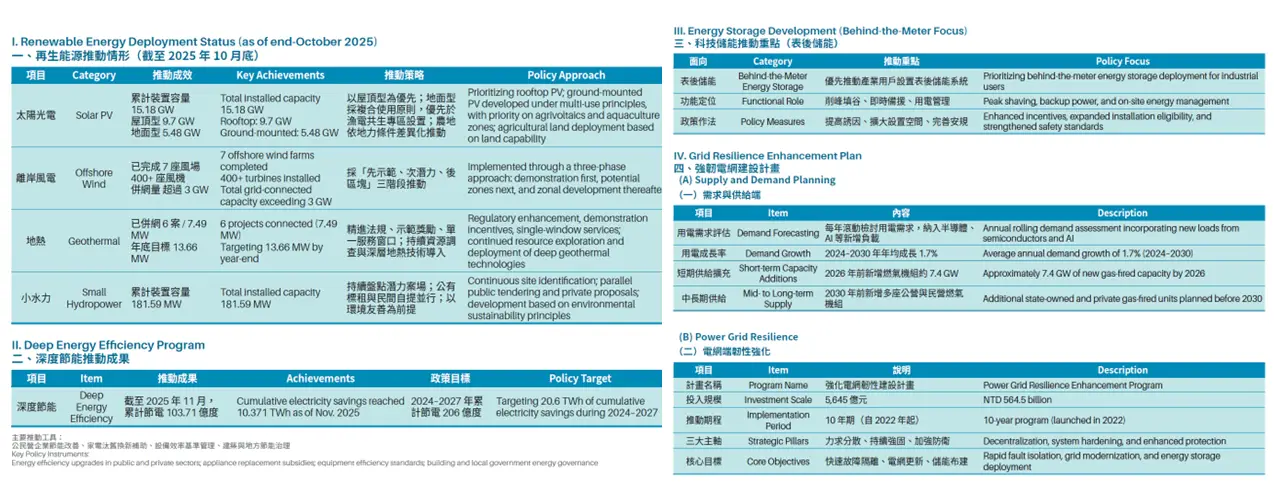
For this reason, the Energy Administration emphasizes both "diversity" and "maximization" in promoting renewable energy. Solar photovoltaics, offshore wind, geothermal energy, and small hydropower each play distinct roles within the system. In the case of solar PV, cumulative installed capacity had reached 15.18 GW by October 2025, with rooftop installations accounting for over 60 percent. Looking ahead, rooftop PV will remain the priority, while ground-mounted projects will follow principles of dual land use and agrivoltaics to avoid conflicts with agricultural land.
Offshore wind development continues to follow a three-phase trajectory—demonstration, potential zones, and zonal development—with cumulative grid-connected capacity exceeding 3 GW. Although geothermal and small hydropower remain relatively modest in scale, they are strategically important for energy diversity and localization. The government is therefore working to lower development barriers through regulatory refinement, demonstration incentives, and a single-window permitting mechanism.
"Energy transition does not rely on a single trump card," Lee stresses. "It depends on the coordinated operation of the entire system." This, he underscores, is the core spirit of the Second Energy Transition.
Source: Energy Administration, Ministry of Economic Affairs (MOEA), Taiwan


Expand your horizons with a paid view:
- Get an exclusive sneak peek at the latest chapter updates.
- Purchase your first magazine NOW!
Already a member? Click here to log in
More related articles
