

MOEA Establishes Ongoing Stakeholder Dialogue Mechanism to Advance Collaborative Net-Zero Solutions
MOEA Establishes Ongoing Stakeholder Dialogue Mechanism to Advance Collaborative Net-Zero Solutions
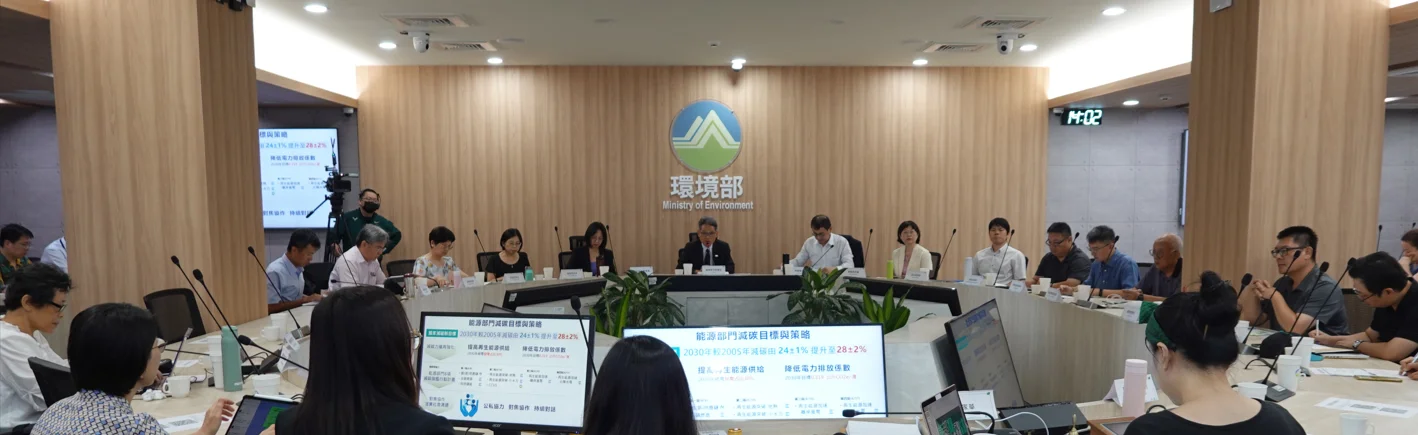
On June 9 and 10, the Ministry of Economic Affairs (MOEA) held the first two social communication meetings under its Comprehensive Carbon Reduction Action Plan for the energy sector, officially launching its regular social communication and collaboration mechanism. These meetings invited a wide range of stakeholders from different fields to participate in discussions and build consensus. Based on the outcomes of these meetings, the MOEA will continue engaging with civil society to clarify contentious issues and collaborate on feasible solutions. The goal is to establish a long-term cooperative relationship between the public and private sectors to jointly implement the Comprehensive Carbon Reduction Action Plan for the energy sector and seek optimal solutions for the second phase of Taiwan's energy transition.
Upon taking office, President Lai established the National Climate Change Committee and mobilized various ministries to formulate a detailed decarbonization roadmap and announce a new national carbon reduction target for 2030 (a 28±2% reduction compared to 2005 levels). The MOEA is mainly responsible for implementing the second energy transition proposed by President Lai, with a strong emphasis on diversifying renewable energy. This not only supports carbon reduction goals but also ensures the supply of green electricity needed by industries. Since promoting green energy requires the participation of all sectors, the MOEA has established a regular communication and collaboration mechanism comprising four stages—initiation, alignment, collaboration, and decision-making support—to gather diverse opinions and forge a consensus on solutions.
To align with the national carbon reduction target, the MOEA first focused on the energy sector's Comprehensive Carbon Reduction Action Plan. On May 19, it held five alignment meetings on solar PV, offshore wind, geothermal, small hydro, and energy storage technologies to identify key issues and potential solutions. These were followed by four social communication meetings (on June 9, 10, 16, and 17) to officially launch the MOEA's regular communication mechanism. Going forward, the ministry will continue working with stakeholders to address critical issues in promoting green energy, aiming to make renewable energy development more environmentally friendly, socially beneficial, and nationally advantageous.
The MOEA stated that on June 9 and 10, it convened two social communication meetings to address six comprehensive carbon reduction projects: "decarbonized fuels and hydrogen," "hydrogen (including ammonia) supply chains," "technology-based energy storage," "geothermal," "small hydro," and "carbon capture, utilization, and storage (CCUS)." Feedback from these sessions will be used to refine the comprehensive plans and enhance transparency in the energy sector. Vice Minister Chien-Hsin Lai emphasized that Taiwan's unique geological conditions require harmonizing renewable energy development with environmental and landscape preservation. The MOEA will implement risk assessments and consider site-specific characteristics to develop guidelines and technical standards for each type of renewable energy. Furthermore, the public must have the right to be informed about energy development and technology trials, along with tangible benefit-sharing mechanisms. The MOEA will instruct relevant agencies to incorporate stakeholder feedback for improvements. Regarding local governance, the ministry plans to use a sandbox approach to identify and allocate appropriate resources to assist local governments in advancing renewable energy, fostering central-local collaboration.
On June 16 and 17, the MOEA will continue with two more social communication meetings focusing on "offshore wind" and "solar PV" to discuss current challenges in their development. Vice Minister Lai stressed that in promoting the energy transition, the MOEA not only aims to ensure stable electricity supply but also values long-term carbon reduction and social well-being. Through its regular communication and collaboration mechanism, the ministry will gather the wisdom and strength of the public and local communities, transforming carbon reduction from mere numerical targets into concrete steps in the energy transition. This will allow all to share in the environmental improvements and economic benefits brought by green energy development, thereby realizing visible and tangible changes in daily life and advancing together toward net-zero emissions and a sustainable future.
