

Five Northern European Countries Join Forces to Cross-Border CO2 Storage
Five Northern European Countries Join Forces to Cross-Border CO2 Storage
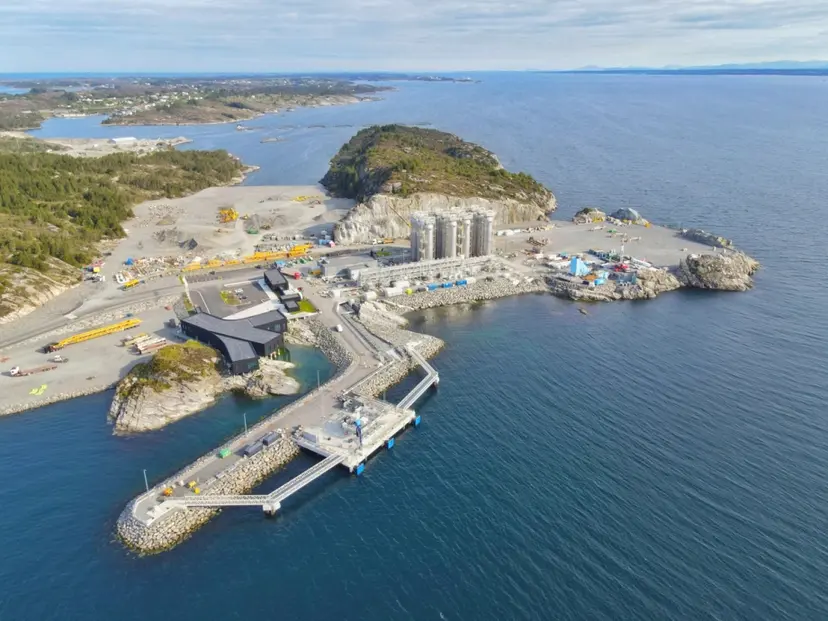
The Northern Light facility under construction at Øgarden
(Source: Equinor)
Five northern European countries – Denmark, Norway, Belgium, the Netherlands, and Sweden – have laid the foundations for Europe’s carbon capture and storage (CCS) infrastructure by joining forces to conclude arrangements on the transport and storage of carbon across borders.
As the ability to move CO2 across borders is perceived to be essential in the quest to create Europe-wide access to a portfolio of potential storage sites, the arrangements between Denmark, Norway, Belgium, the Netherlands, and Sweden, made on April 15, pave the way for cross-border transport and geological storage of captured CO2. Sweden and Denmark have also made a similar arrangement which allows for the removal of some of the obstacles on the way to a well-functioning carbon capture and storage market in the wide North Sea region.
Terje Aasland, Norway’s Minister of Energy, commented: "Norway has great potential to store CO2 and I am pleased that other countries will store CO2 in Norwegian storage sites. The capacity is enormous. The climate challenge transcends borders, and it is crucial that we put in place solutions for the transport of CO2 across national borders. This is an important day for the climate, for our industries, and for the first full-scale European CCS project, Longship."
The Northern Lights project is part of the Norwegian full-scale CCS project called "Longshi". The full-scale project includes the capture of CO2 from industrial sources and the shipping of liquid CO2 to an onshore terminal on the Norwegian west coast. From there, the liquified CO2 will be transported by pipeline to an offshore storage location subsea in the North Sea for permanent storage. This CCS project demonstrates Norway's efforts to develop a full-scale carbon capture and storage value chain. Owned by Equinor, Shell, and TotalEnergies, Phase 1, with a capacity to inject up to 1.5 million tons of CO2 per year, is scheduled to be ready for operation in 2024. The captured and liquefied CO2 from European emitters will be loaded and delivered to the receiving terminal in Øygarden on board two LNG-powered, wind-assisted CO2 transportation ships.
Jacob K. Clasen, Deputy CEO of Danish Shipping, noted: "When it comes to capturing and storing CO2 underground, Denmark is right at the forefront. It's very positive that the Danish government is also proactive in establishing agreements with our neighboring countries, which can contribute to scaling up the entire CO2 sector and establishing the necessary infrastructure. At Danish Shipping, we have members ready with the ships that will help transport CO2. All this can help make Denmark an important European CO2 hub."
Danish Shipping, which sees Scandinavian CO2 cooperation as a crucial step in establishing European CO2 infrastructure, has underlined that the new agreements with Norway and Sweden enable the transport of CO2 across Scandinavia for underground storage. The company believes that CCUS (Carbon Capture Utilisation and Storage) has the potential to become a new Danish industrial adventure.
Paul Van Tigchelt, Belgian Minister of the North Sea, remarked: "Developing new methods to reduce CO2 emissions is crucial for the future of our planet. This is a promising climate technology. The sea can play a key role in this regard. Not only has it always been of great importance in regulating our climate, but it also offers opportunities for carbon capture and storage. Over the past 2 years, we have already concluded agreements with the Netherlands and Denmark. Now, we are taking another important step with Norway to store captured CO2 in their depleted oil and gas fields."
Alongside renewable energy and energy efficiency measures, the rollout of CCS is seen as the right move to curb the footprint of greenhouse gas emissions. In line with this, Zuhal Demir, Flemish Minister for Justice and Enforcement, Environment, Energy and Tourism, is convinced that the cooperation between Flanders and Norway will serve as a boost for the future development of the CCUS-value chain since Norway's great potential turns the country into fertile ground for the storage of CO2.
Romina Pourmokhtari, Sweden’s Minister for Climate and Environment, outlined: "CCS and BECCS (BioEnergy with Carbon Capture and Storage) will play a key role towards EU's 2050 objective for climate neutrality and negative emissions thereafter. Sweden has great potential for BECCS, and we already have projects underway. These agreements are essential for Sweden and its industry to realize a fossil-free future."
Lars Aagaard, Danish Minister for Climate, Energy and Utilities, emphasized: "In order to decarbonize hard-to-abate sectors, we need carbon capture and storage. In order to reach climate neutrality by 2050 in Europe, we need carbon capture and storage on a larger, international scale. Today's arrangements are two great steps in the right direction. It’s all hands on deck – and I'm glad to see both Norway and Sweden joining our work towards an international industry for carbon capture and storage." The agreements come after Denmark, France, Germany, Sweden, and the Netherlands took steps to bolster cooperation within the European Union (EU) on carbon capture and storage with a declaration that paints CCUS as a key climate tool.
Reference: Offshore Energy
