

Carbon Pricing Era Begins in Taiwan with Ministry of Environment's Announcement of 3 Key Carbon Fee Regulations
Carbon Pricing Era Begins in Taiwan with Ministry of Environment's Announcement of 3 Key Carbon Fee Regulations
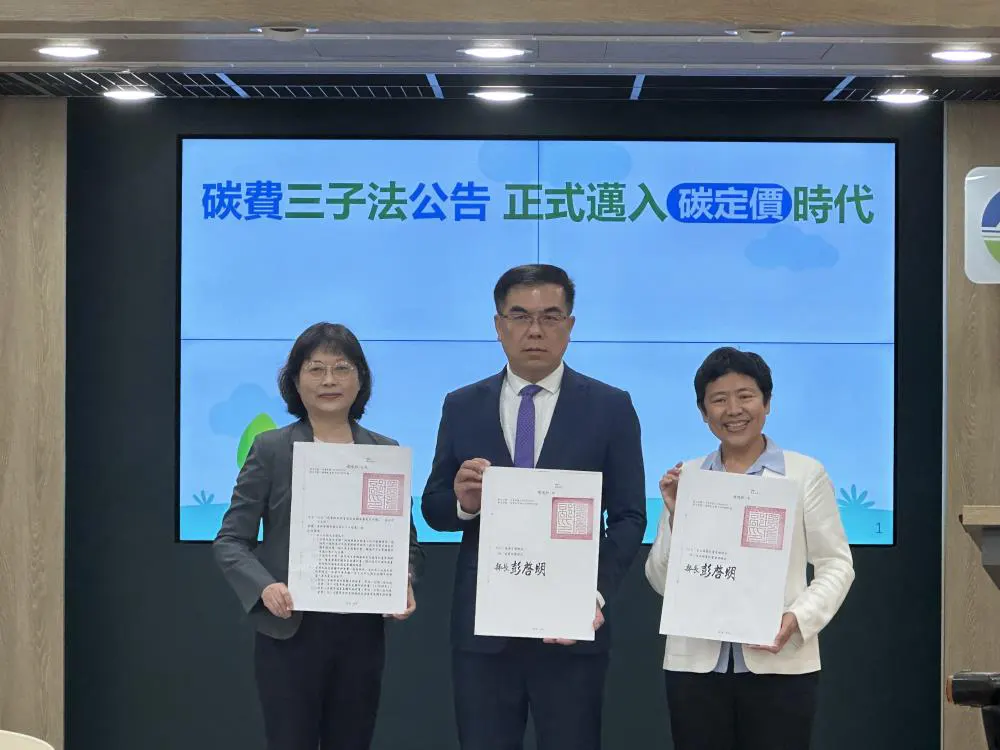
To establish Taiwan's carbon pricing system and ensure the steady advancement of carbon reduction efforts, the Ministry of Environment, following the "Climate Change Response Act" (referred to as the Climate Act), has issued the "Regulations Governing the Collection of Carbon Fees" and the "Regulations for Administration of Voluntary Reduction Plans." Alongside these, it has also announced the "Carbon Fees Levying and Designated Greenhouse Gas Reduction Subjects," thereby completing the 3 supporting regulations of the carbon fee system. This move aligns with President Ching-te Lai's strategy of promoting the "dual transformation of digital and green industries." The government encourages enterprises to transition to low-carbon operations by driving carbon pricing and market mechanisms. Implementing the carbon fee system officially marks Taiwan's entry into the carbon pricing era.
The Ministry of Environment emphasized that imposing carbon fees aims to accelerate and intensify carbon reduction efforts. If entities subject to carbon fees can submit voluntary reduction plans, 37 million tons of CO2e could be reduced by 2030, which is approximately 14% of the 2005 emission levels. In collaboration with the Ministry of Economic Affairs, the Ministry will hold over 10 explanatory sessions and allow ample time for businesses to prepare and plan their carbon reduction measures leading up to 2030. Businesses are encouraged to find the most suitable reduction paths and technologies for themselves, supported by preferential rates and related assistance mechanisms from the Ministry of Economic Affairs, thereby creating opportunities for green growth.
On April 29th, 2024, the Ministry of Environment pre-announced the draft of the three supporting regulations for the carbon fee system. The Ministry also organized 9 explanatory sessions and 1 public hearing with industry and civil society groups to engage in comprehensive discussions on issues such as the "deduction of the threshold for fee imposition," "identification of high carbon leakage risk industries," "adjustment coefficients and timelines for emission levels," "use of domestic reduction quotas for carbon offsets," "setting of base years and benchmark values for designated targets," and "public disclosure of information on voluntary reduction plans." After considering the feedback and suggestions from various sectors regarding the three supporting regulations, the Ministry adjusted the provisions accordingly. Below are the key points of the 3 carbon fee regulations.
1. Carbon Fees Levying Method:
1-1. Carbon Fees Levying Subjects:
Entities subject to the "Requirements for Business Entities to Inventory, Register, and Verify Greenhouse Gas Emissions Sources" with a total annual greenhouse gas emission, combining direct emissions and indirect emissions from electricity use, of 25,000 metric tons or more of CO2 equivalent. This includes the power supply, gas supply, and manufacturing sectors. Additionally, to ensure fair competition within the same industry, businesses may, in principle, deduct the threshold of 25,000 metric tons of CO2 equivalent when calculating their fee-paying emissions.
1-2. Fee Payment Schedule:
Fee-paying entities must report and pay carbon fees based on the greenhouse gas emissions from January 1 to December 31 of the previous year by the end of May each year, starting from the year after the carbon fees rate announcement becomes effective.
1-3. Carbon Fees Calculation:
Carbon fees are calculated by multiplying the "fee-paying emissions" by the "imposition rate." The calculation of "fee-paying emissions" refers to practices in countries such as the EU, South Korea, and Singapore (e.g., granting partial free allocation or tax exemptions). An emission adjustment mechanism is designed within the fee levying method to prevent carbon leakage. The Ministry emphasizes that businesses must first obtain an approved self-reduction plan to apply for recognition as a high-risk industry for carbon leakage. This will be applicable in three phases with different emission adjustment coefficients. The emission adjustment schedule will also take into account the phase-out of international free allocation, the effectiveness of domestic emission reductions, and the international competitiveness of industries, with further announcements to be made. Additionally, fee-paying emissions in these industries are not allowed to deduct the threshold of 25,000 metric tons of CO2 equivalent.
2. Carbon Fees Levying and Designated Greenhouse Gas Reduction Subjects
In accordance with Article 29 of the Climate Act, carbon fees levying subjects that effectively reduce greenhouse gas emissions by switching to low-carbon fuels, adopting negative emission technologies, enhancing energy efficiency, using renewable energy, or improving processes, and thus achieve the "designated subjects" set by the central competent authority, may submit Voluntary Reduction Plans to apply for "preferential rates."
2-1. Designated Reduction Subjects:
Two calculation methods are established for the designated subjects. The first refers to industry-specific reduction rates recommended by the Science Based Targets Initiative (SBTi), and the second is based on domestic and international emissions benchmarks and the technical benchmarks set to achieve the 2030 Nationally Determined Contribution.
2-2. Voluntary Reduction Plans:
Levying subjects wishing to apply for preferential rates must select the designated reduction rate from the designated subjects and calculate the subject annual greenhouse gas emissions for 2030 as the designated subjects. They must then plan the annual carbon reduction pathway up to 2030 (including the progress of annual reduction measures and greenhouse gas emissions) and submit the Voluntary Reduction Plans for approval by the central competent authority.
2-3. Regular Effectiveness Review:
The central competent authority will annually verify the progress of the Voluntary Reduction Plans. Businesses must submit the progress report of the previous year's plan execution by the end of April each year. If the progress meets the requirements, the preferential rate will be applicable for that year. If the central competent authority finds that the business has not implemented the plan as required, the difference between the general and preferential rates for that year will be recovered according to law, and the business will be required to make improvements within a specified period. Failure to improve within the timeframe will result in the cancellation of the Voluntary Reduction Plans.
Finally, to encourage carbon fees levying subjects (large emission sources) to lead non-carbon fees levying subjects in reduction efforts and to prioritize keeping funds within the country, the Ministry of Environment has set a ratio of 1.2 for the deduction of emissions by using voluntary reduction projects and offset projects. However, the deduction limit using reduction credits cannot exceed 10% of the emissions subject to levying. Additionally, to acknowledge early reduction efforts by businesses, it is stipulated that enterprises not at high risk of carbon leakage may use early project reduction credits to deduct emissions at a ratio of 0.3 in the three years prior to the implementation of carbon fees. Furthermore, to provide additional supportive measures for industries not at high risk of carbon leakage, such industries may use foreign reduction credits recognized by the central competent authority, but the deduction limit cannot exceed 5% of the emissions subject to levying.
The Ministry of Environment pointed out that carbon pricing is already an international trend. The Ministry plans to hold the 5th Carbon Fees Rate Review Meeting on September 9th to discuss the impact of different rate scenarios on individual industries. It is estimated that the rate review and announcement will be completed by the end of the year, thus finalizing the last piece of the carbon pricing system in the country and steadily advancing towards the goal of net-zero transition.
